

African American Women with MS: Insight Into Challenges and Outcomes
A Note From We Are ILL
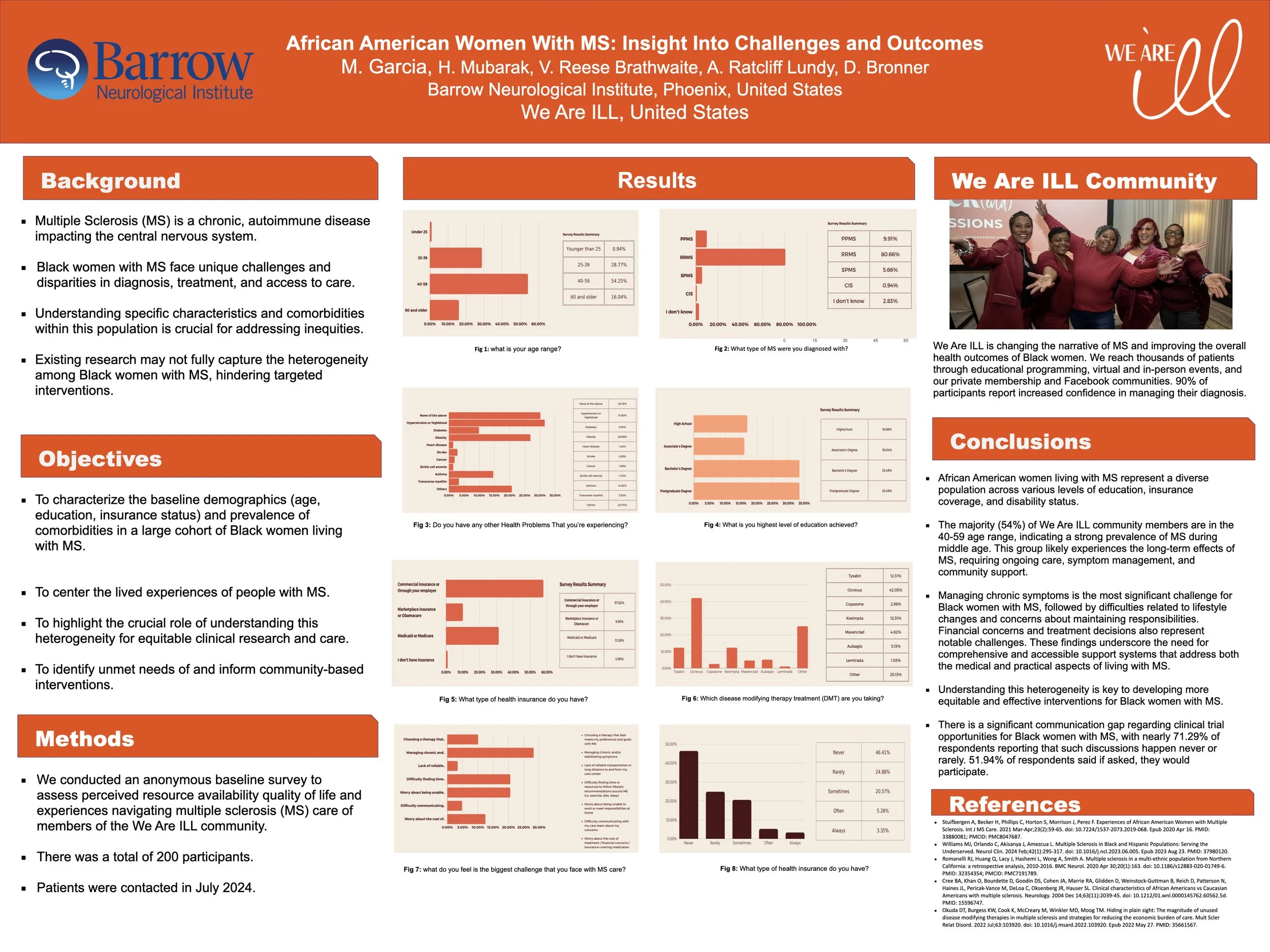
This year at the ACTRIMS Forum, We Are ILL presented a poster, in collaboration with Barrow Neurological Institute, that centers a group too often overlooked in multiple sclerosis research: Black women living with MS. Titled “African American Women with MS: Insight into Challenges and Outcomes,” the poster draws from our 2024 community survey and offers one of the most community-grounded snapshots of this population to date.
With 200 responses from Black women across age groups, education levels, and insurance types, the data paints a clear picture: There is no single story of MS in our community. Many respondents hold bachelor’s or postgraduate degrees, yet a significant portion rely on Medicare or Medicaid. Common comorbidities like hypertension, obesity, asthma, and diabetes surfaced at notable rates — factors that deeply shape treatment, quality of life, and long-term outcomes. This level of detail matters. It challenges assumptions. It pushes the field toward care and research that reflect real lives, not stereotypes.
The significance of this moment cannot be overstated. Our community-generated data was not collected in a lab removed from lived experience. It came directly from the women we serve. Presenting at ACTRIMS signals that the insights of Black women with MS belong in scientific spaces, policy conversations, and clinical decision-making. It affirms that equitable research begins by listening to the people most impacted.
We’re proud to contribute to the growing call for inclusive research, culturally informed care, and targeted interventions for Black women with MS. And we’re just getting started.
Authors
M. A. Garcia-Dominguez1, D. Bronner2, V. Reese Brathwaite3, A. Ratcliff Lundy3, H. Mubarak4; 1Neurology, Barrow Neurological Institute, Phoenix, AZ, 2Empactful Ventures, Irvine, CA, 3We Are ILL, Atlanta, GA and Long Beach, CA, 4Barrow Neurological Institute, Phoenix, AZ.
Abstract
Background & Objectives:
Objective: To characterize the baseline demographics, including age, education, and insurance status, and the prevalence of comorbidities in a large cohort of Black women living with Multiple Sclerosis (MS). Understanding this heterogeneity is crucial for equitable clinical research and care.Background: Multiple Sclerosis (MS) is a chronic, autoimmune disease affecting the central nervous system. While MS impacts individuals across various demographics, Black women often face unique challenges and disparities in diagnosis, treatment, and access to care. Understanding the specific characteristics and comorbidities within this population is crucial for addressing these inequities. Prior research may not fully capture the heterogeneity present within Black women living with MS, hindering the development of targeted and effective interventions.
Methods: We analyzed data from the 2024 We Are ILL Membership Survey, a community-based survey of African American women with MS. The survey collected detailed information on demographics, health status, and comorbidities. Descriptive statistics were used to summarize the cohort’ s characteristics.
Results: With 200 responses to the survey, the age across the cohort ranged from younger than 18 to older than 65. Regarding education, 67% included bachelor and post-graduate level of education. When it came to insurance coverage, 0.95% didn’t have insurance coverage, 31.28% were on Medicare or Medicaid, 57.8% had commercial insurance and 9.95% had marketplace insurance. The most common comorbidities included hypertension at 31.6%, obesity at 26.8%, asthma at 14.6% and diabetes at 9.91%.
Conclusions: African American women living with MS represent a diverse population with varying levels of education, insurance coverage, and disability status. This underscores the need for inclusive research practices and awareness of common comorbidities in this population. Understanding this heterogeneity can facilitate the development of more equitable and effective interventions for Black women with MS.